Work From Anywhere 5 January 2026
219Views 0Comments

This isn’t a break from work, and it isn’t an experiment.
Over the coming weeks, I’ll be travelling around Europe while continuing my role as normal. Same responsibilities. Same expectations. Same working hours. The only thing that changes is where I happen to be when I open my laptop.
That’s intentional.
This plan has been agreed in advance with my company’s management, HR, and legal teams. It follows established ways of working and isn’t a special arrangement. I’m not the first person to work this way, and I won’t be the last.
Nothing about this is informal or improvised.
Work continues. Locations change.
I’m normally based from home. That’s not a recent change, and it’s not unusual in my role. I regularly travel around the country to meet customers, and I go into the office for planned events and team sessions throughout the year.
My workday already isn’t tied to a single building.
I also work closely with colleagues across multiple countries. Day to day, I collaborate with people in the UK, France, Bulgaria, Spain, and the United States. That kind of geographic spread isn’t an edge case. It’s how the work already happens.
Travelling within Europe doesn’t introduce a new way of working. It simply makes visible what’s already true.
There’s often an assumption that being away from a fixed office makes work fragile. That availability drops. That reliability becomes a gamble.
My experience has been the opposite.
I’ve worked remotely, in one form or another, for over 25 years. That experience has allowed me to work with some exceptional organisations globally, long before remote work became a headline topic.
When COVID struck, very little changed for me or the teams I worked with. The work continued in the same way it always had. The main difference was that I wasn’t travelling to visit customers in person.
That reinforced something I already knew: when work is designed around continuity rather than presence, location becomes a variable, not a risk.

When I joined RingCentral, customer care and technical support in the UK were deliberately designed as work from anywhere roles as part of our business continuity planning.
The expectation was simple. Work should continue regardless of where people are physically located.
That’s why day-to-day work already happens using laptops, the RingCentral app, and the same collaboration tools, wherever we are. The setup isn’t a workaround. It’s the intended design.
That distinction matters.
I won’t be travelling on my own.
I’ll be with my partner of over 20 years, who also works at RingCentral. Like me, his role is already designed to work independently of location. We both use the same tools, follow the same expectations, and work within the same frameworks we do at home.
That shared context matters. It means the working day remains familiar and predictable, even when we’re somewhere new.
Again, nothing exceptional. Just continuity, shared.
Platforms and tools matter, but they aren’t the story here.
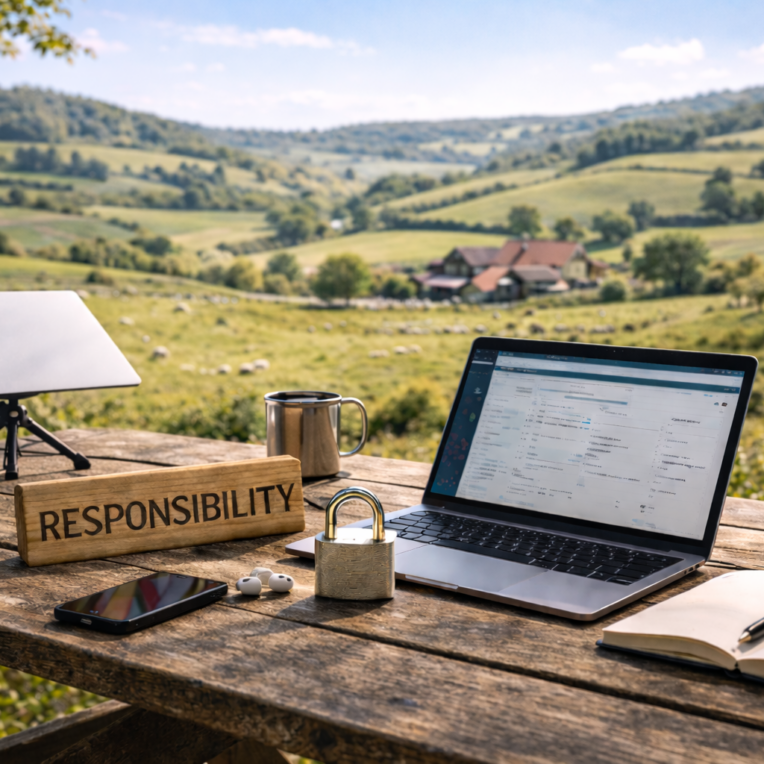
The real enabler of working from anywhere is responsibility. Knowing when and where work is appropriate. Making good decisions about environment, privacy, and focus. Treating continuity as something you design for, not something you hope for.
This series isn’t about proving that working from anywhere is possible. That question has already been answered.
It’s about showing that it can feel normal.
Some readers will want to know how continuity is supported in practice. That’s fair.
I’ll cover more technical aspects in separate, clearly marked posts for anyone who’s interested. That includes high-level discussions about connectivity, resilience, and tools I use, such as Starlink, Ubiquiti, and Synology.
Those posts won’t be required reading to follow this journal. They’ll be there for people who enjoy the detail, without making the main story harder to follow.
A lot of writing about remote or nomadic work makes it sound either risky or exceptional.
This journal exists to show something quieter.
That it’s possible to work normally while moving between places.
That preparation reduces stress rather than adding to it.
That continuity is something you design for in advance.
Some days, very little will happen. That’s exactly the outcome I’m aiming for.
Before the journey starts, I’ll write about how I prepare for continuity. Not in technical detail, but in mindset and approach.
Once the trip begins, I’ll share short, regular notes from the road. Where I am. How the day went. What worked. What needed adjusting.
No drama. No performance.
Just work, continuing.